Aldinga Drop Off
The
Aldinga drop off is on the edge of the Aldinga reef lying 1.5 kms off the Aldinga
beach. Access is via boat which can be launched from the Southern end of Aldinga
Beach or from O'Sullivan's Beach ramp. The reef drops away from 5m to 21m creating a
spectacular
dive that is a mass of caverns, crevasses and overhangs. The reef is inside an
aquatic reserve and fish abound making this
a photographers paradise. The drop off is
where the big schools of snapper stay when travelling north to their breeding
grounds. When the snapper are running it is advisable not to dive this area as
the snapper school is occasionally followed by white pointer sharks.
GPS 36:16:270 S
138:25:799 E

Aldinga Pinnacles
Part
of the Aldinga reef system closer in shore from the drop off. Spectacular dive
with lots of swim throughs, overhangs, fish life and weed growth. The dive is in
only 8m of water so an extended amount of time can be spent exploring the reef
system, the overhangs and occasional cave. Visibility here is generally very
good and swimming amongst rock pinnacles extending from the sea floor to just
beneath the surface of the sea is very different to other SA dives.
GPS 35:16:010 S
138:26:020 E


Black's Reef
Black's reef is between the Bluff and Wright Island in Encounter Bay at
Victor Harbour. It is quite a swim if done as a shore dive. Alternatively access
is by boat from the Bluff boat ramp. There is an extensive reef system with
depths to 14m.

ExHMAS Hobart
The
ex HMAS Hobart was a Charles F. Adams class guided missile destroyer in
the Royal Australia Navy (DDG 39), built in the United States of America and
commissioned in 1965 in Boston. The vessel completed three tours of duty off Vietnam
and in 1968, two sailors lost their lives and seven others were injured after
the vessel was hit by "friendly" fire. The Hobart was sunk in November
2002 as an artificial reef and lies in 30 metres of water approximately 4 kms
off Rapid Bay. Access is by boat from Sunset Cove boat ramp and a permit system
applies. The 134m wreck which takes several visits to see it all caters for all
levels of diving experience.
GPS


Fisheries Beach
The beach is east of Cape
Jervis. A shore dive, to the right of the sandy beach is a line of rocks that goes out 50 metres into
the water. Directly out from that is a reef 3-400 metres offshore, that runs
parallel to the shore. The reef isn't overly high, but there is a quite a bit of life on
it. Around the reef, and between the reef and shore, are heaps of
anchors, cart wheels chain, etc. that are almost 100 years old.

Gull Rock
Gull
Rock is a small island close to shore at the southern end of Maslin's Beach. A
reef extends out from the rock for several hundred metres. Access to the reef is
by boat from O'Sullivan's Beach boat ramp or from the beach south of Aldinga
Reef. The reef extends from just below the surface to around 10m.
GPS 35:14:590 S 138:27:570 E


Lassiter's Reef
It
is a 50m diameter dome shaped reef in 8m of water. The is a surprising variety
of sea life and residents include the leafy sea dragon. Access is by a long swim
from the beach at Second Valley or by boat from Sunset Cove boat ramp.


Myponga Beach
A great shore dive with lots of crevices, walls and ledges. Most of the dive, there is a 4-5 metre vertical wall, with lots of drummer,
Talma, old wives, goat fish and leatherjackets hanging around.

Rapid Bay Jetty
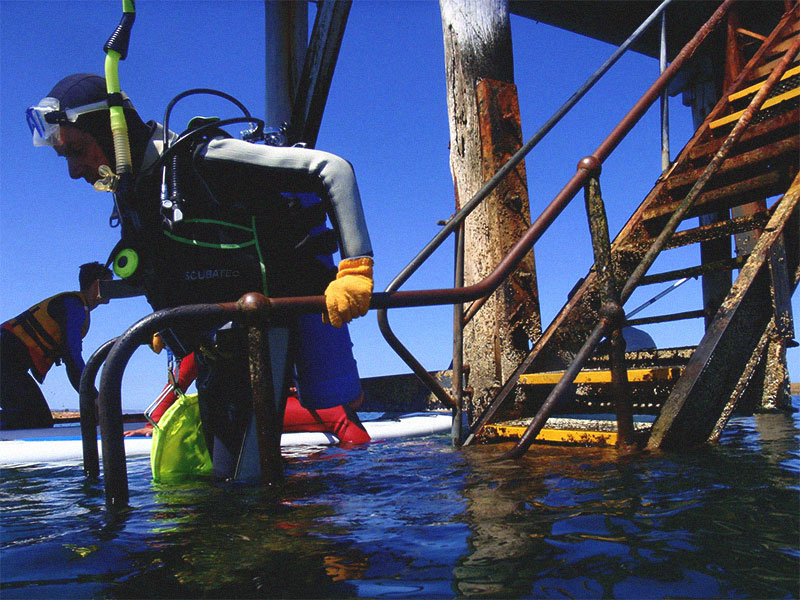
This is one of the best jetty dives in Australia, with lots of growth on the
pylons and huge numbers of fish under and around the jetty. Access is from the
shore over the rocks or by boat from Sunset Cove boat ramp. There are schools of trevally, morwong, yellowtail, Tommy ruff, old wife and
other common species. Very large dusky morwong are common, as are the wonderful
gurnard perch and other hidden finds. The real special thing about the jetty, is the high likelihood of a sighting of
the leafy sea dragon. The more common weedy sea dragon is also very often found here. There is usually
plenty for those interested in the little critters which inhabit the nooks and
crannies.


Rapid Head
An
interesting dive site, with a vertical wall, from the bottom which varies from
6-8m deep and usually an abundance of fish life. Access
is by boat from Sunset Cove boat ramp. There
is a fairly low rocky reef system, that heads out to sea from the wall.

Second Valley
On the southern side of the jetty are 3 small bays. A shore dive, entry can
be made by walking around to the second bay. South of this bay and cut into the
cliff face are 3 small caves including a swim through with a right angle in it.
Fish life is often sparse but leafy and weedy sea dragons are sometimes seen.

Star of Greece
The
Star of Greece was built in Belfast in 1868 and was a 1227 ton, three masted ship.
The ship ran aground just north of Port Willunga in the early hours of 13 July
1888 having left Port Adelaide the previous afternoon. A permanent bouy marks
the wreck and access is by long walk and snorkel or by boat
launched
from the Southern end of Aldinga Beach or from O'Sullivan's Beach ramp. Despite
being wrecked only 200m from shore in 6m of water, only 10 of the crew of 27
survived. When clear of the sand which can almost cover the entire wreck a lot
of wreckage can be seen.
GPS 35:15:143
S 138:27:562 E

The Blowhole
This site is in Deep Creek Conservation Park 80 kms south of Adelaide and is
only accessible by four wheel drive. You need to follow the signs through the
park, down the dirt road to the car park. Four wheel drive only from the carpark
down a very steep track to the end. Follow the steep walk/path several hundred
metres to a small beach. Entry is anywhere from the beach. This is a beautiful
unspoilt site. It is teeming with life, crays galore, seals and sea dragons. You
do have to watch for heavy current and freak waves and its strongly advised you
dive with someone who knows the area - at least at first.

The Bluff
The Bluff at Victor Harbour is an awesome
in good conditions. Entry is from the small wharf on the eastern side of the
Bluff. Leafy sea dragons are often seen here. There are also seals, seahorses, weedy sea dragons,
crayfish, nudibranchs, plus lots and lots of fish.
The area is strewn with big granite boulders, stacked one on top of the other,
with big holes, ledges, swim throughs, etc. In the holes are a big variety of
sponge, and soft coral life, as well as the occasional nudibranch. Depth ranges from 4m to 40m.


Whale Bones
Whale bones is in
Encounter Bay at Victor Harbour. Follow the road to the bluff and turn off at
the hospital. Whale bones is the reef in front of and to the right where this
road meets the beach. Access is from shore over a 100 or so metres of knee deep
water or by boat from the nearby Bluff boat ramp. This is a
big system of limestone caves, undercuts, swim-throughs, and reef. It is a
virtual honeycomb of caves, and passages. The top of the reef is only in about
2-3 metres of water, with lots of holes in the top, that lead down into the
caves. If you head out to sea, you will also see a drop-off, which also leads
into the caves.
The site got its name from the fact that there used to be lots of whale bones in
the area, as the whalers used to dump the whale carcasses in the area.